
The year is 2024, and the cryptocurrency landscape is more dynamic than ever. With Bitcoin continuing to dominate headlines, altcoins are quietly revolutionizing the industry. At Coinreviews, we’ve delved deep into the world of altcoins to uncover the innovative projects and groundbreaking technologies that are shaping the future of finance.
In this comprehensive guide, we’ll explore the latest trends, potential investment opportunities, and the potential impact of altcoin on our daily lives.
What Is An Altcoin?
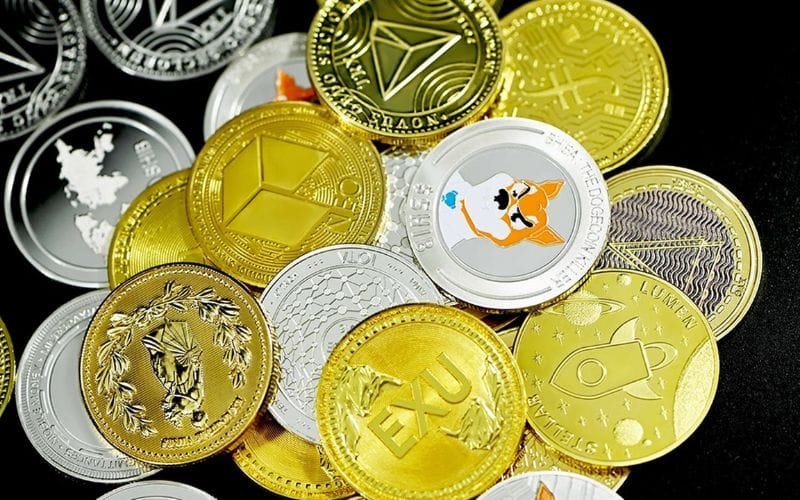
An altcoin refers to any cryptocurrency other than Bitcoin (BTC). Some people also exclude Ethereum (ETH) from this definition, as most cryptocurrencies are built by forking from either Bitcoin or Ethereum. Many altcoins employ different consensus mechanisms to validate transactions, create new blocks, or distinguish themselves by offering new features or functionalities that set them apart from Bitcoin and Ethereum.
Most altcoins are launched by developers who have unique visions or specific use cases for their cryptocurrency. Understanding altcoins is key to seeing how they differ from Bitcoin and how they expand the possibilities within the cryptocurrency space.
How is Altcoin understood?
Main Points
- Altcoins include all cryptocurrencies except Bitcoin, and sometimes Ethereum.
- There are thousands of altcoins currently available in the market.
- Altcoins can be categorized based on their purpose or design.
- While the future of altcoins remains uncertain, their continued existence depends on the ongoing use and development of the underlying blockchain technology.
History And Evolution Of Altcoins
Early Days of Cryptocurrency and Bitcoin Dominance
The cryptocurrency world began with the creation of Bitcoin in 2009 by an unknown entity known as Satoshi Nakamoto. As the first decentralized digital currency, Bitcoin introduced a new financial paradigm, challenging traditional banking systems with peer-to-peer transactions and the use of blockchain technology.
For several years after its creation, Bitcoin dominated the cryptocurrency market, with no major competitors. However, its primary function was as a store of value and a medium of exchange, leaving gaps in functionality for other innovative use cases.
The Emergence of the First Altcoins
In response to the limitations of Bitcoin, developers began experimenting with new blockchain technologies. These alternatives, referred to as “altcoins” (short for “alternative coins”), aimed to address the shortcomings of Bitcoin and introduce new features.
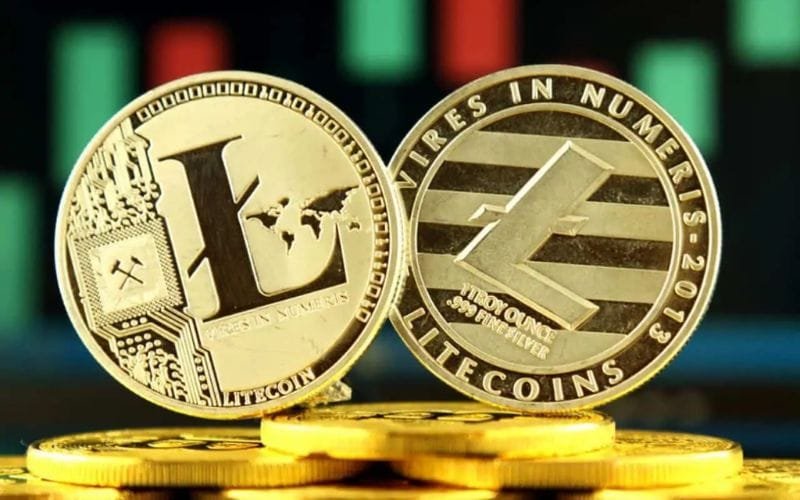
Litecoin (2011): Often considered the first successful altcoin, Litecoin was created by Charlie Lee as a “lighter” version of Bitcoin. It offered faster transaction times and a different hashing algorithm (Scrypt), which made it easier to mine for everyday users compared to Bitcoin’s SHA-256.
How is Litecoin different from Bitcoin?
Namecoin (2011): Another early altcoin, Namecoin aimed to decentralize domain registration and increase internet censorship resistance. It was one of the first attempts to go beyond the financial utility of cryptocurrency.
These early altcoins primarily focused on improving the technical aspects of Bitcoin, such as transaction speed, mining accessibility, or privacy, but they paved the way for more ambitious projects.
Evolution of Altcoins: Smart Contracts, Privacy, and Innovation
As the cryptocurrency landscape matured, new altcoins introduced groundbreaking innovations that significantly expanded the capabilities of blockchain technology. This next wave of altcoins diversified into various fields, offering more than just a means of exchange.
Ethereum (2015): Ethereum, founded by Vitalik Buterin, was the most significant innovation in the altcoin space. It introduced the concept of smart contracts, self-executing contracts with the terms of the agreement directly written into code. Ethereum’s blockchain served as a decentralized platform for running decentralized applications (dApps), opening the door to new use cases like DeFi (decentralized finance) and NFTs (non-fungible tokens).
Monero (2014): As privacy concerns grew within the cryptocurrency community, Monero emerged as a leader in privacy-focused altcoins. Monero used advanced cryptographic techniques like ring signatures and stealth addresses to ensure transaction anonymity and untraceability, setting it apart from the more transparent Bitcoin blockchain.
Zcash (2016): Another privacy coin, Zcash offered users the option to shield their transactions using zero-knowledge proofs, allowing private and transparent transactions to coexist on the same blockchain. Zcash’s zk-SNARKs technology became a key innovation in enhancing privacy without compromising blockchain security.
Ripple (2012): Aiming to revolutionize cross-border payments, Ripple (XRP) focused on real-time gross settlement and currency exchange. It built partnerships with financial institutions and offered fast, low-cost international transactions, differentiating itself from Bitcoin’s vision as a decentralized, person-to-person currency.
These innovative altcoins significantly expanded the cryptocurrency market’s horizons, introducing features like programmability, privacy, and enhanced transaction mechanisms. This evolution continued to spur further experimentation and development, leading to the emergence of thousands of altcoins, each serving specific purposes or targeting niche markets.
Understanding Altcoins
The term “altcoin” is a combination of “alternative” and “coin,” referring to all cryptocurrencies and tokens other than Bitcoin. Altcoins are typically designed for specific blockchains, and many are forks of existing blockchains like Bitcoin or Ethereum. These forks often happen when developers disagree with the original project and decide to create their own coin, resulting in a new altcoin.
Altcoins usually serve specific purposes within their respective blockchain ecosystems. For example, ether (ETH) is used on the Ethereum network to pay for transaction fees. Some altcoins, like Bitcoin Cash, emerged from forks of Bitcoin with the aim of improving upon or competing with Bitcoin as a payment method. Other altcoins, like XRP from Ripple, are designed to serve particular industries, such as banking, by offering faster transaction processing.
Are Altcoins Harder to Use Than Bitcoin?
Altcoins often try to address limitations in the blockchain they originated from. The first altcoin, Litecoin, was created in 2011 as a fork of Bitcoin and introduced a different proof-of-work (PoW) consensus mechanism called Scrypt, which is faster and less energy-intensive than Bitcoin’s SHA-256.
Ether is another prominent altcoin, though it was not forked from Bitcoin. It was developed by Vitalik Buterin, Dr. Gavin Wood, and others specifically for the Ethereum network, which is the largest blockchain-based virtual machine. Ether is used not only to pay for transaction validation on the Ethereum network but also as collateral in staking, allowing users to become validators and propose new blocks.
What Are The Types Of Altcoins?
Altcoins come in various types, depending on how they function and what their purpose is. These include stablecoins, mining-based coins, staking-based coins, and governance tokens. Each type of altcoin has unique characteristics, making them suitable for different use cases within the cryptocurrency ecosystem.
Stablecoins
Stablecoins are altcoins designed to maintain a stable value by being pegged to another asset, usually the U.S. dollar. They aim to mirror the value of that asset, and if the price shifts, the issuer of the stablecoin intervenes to bring it back to its intended value. Stablecoins are typically not used for investment purposes, as they are designed to hold a consistent value. Instead, they are commonly used for saving, transferring funds, or earning interest through lending or savings protocols.
Mining-based Altcoins
Mining-based altcoins rely on a process called mining to validate transactions and add new coins to the supply. Miners solve complex mathematical problems, and the first to solve it gets the right to verify a block of transactions. As a reward, miners earn cryptocurrency. Since Bitcoin itself is mining-based, this method was the original approach for processing transactions in the crypto space. However, mining can consume significant energy, which is considered one of its drawbacks.
 Which Altcoins Are Worth Mining?
Staking-based Altcoins
Staking-based altcoins use staking to verify transactions and generate new coins. Holders of these altcoins can stake their coins, which means pledging them to be used for transaction processing. The blockchain protocol then selects a participant to verify the next block of transactions, and in return, the participant earns rewards. Peercoin (PPC) was one of the first altcoins to introduce staking. Although it didn’t become widely known, staking has since gained popularity due to its energy efficiency compared to mining.
Governance Altcoins
Governance altcoins give holders the ability to vote on decisions that affect the future of the project. These tokens allow users to create and vote on proposals, making the cryptocurrency more decentralized since decisions are made by the community rather than a single central authority. Governance altcoins play a key role in ensuring that the direction of the project reflects the interests of its holders.
Popular Altcoins to Watch in 2024
Which Altcoins Are Popular in 2024?
Ethereum (ETH): As the leading platform for smart contracts and decentralized applications (dApps), Ethereum continues to be a pivotal player in the altcoin market.
Cardano (ADA): Renowned for its scientific approach to blockchain development, Cardano emphasizes research-driven protocols and sustainability.
Polkadot (DOT): Polkadot focuses on enabling interoperability between different blockchains, making it a significant player in the multi-chain ecosystem.
Solana (SOL): Known for its high-speed transactions and low fees, Solana aims to provide an efficient and scalable platform for decentralized applications.
Chainlink (LINK): As a leader in decentralized oracle networks, Chainlink connects smart contracts with real-world data, enhancing the functionality of various blockchain applications.
Avalanche (AVAX): With a focus on scalability and rapid transaction speeds, Avalanche is designed to support complex decentralized applications and enterprise blockchain solutions.
What’s the difference between Bitcoin and altcoins?
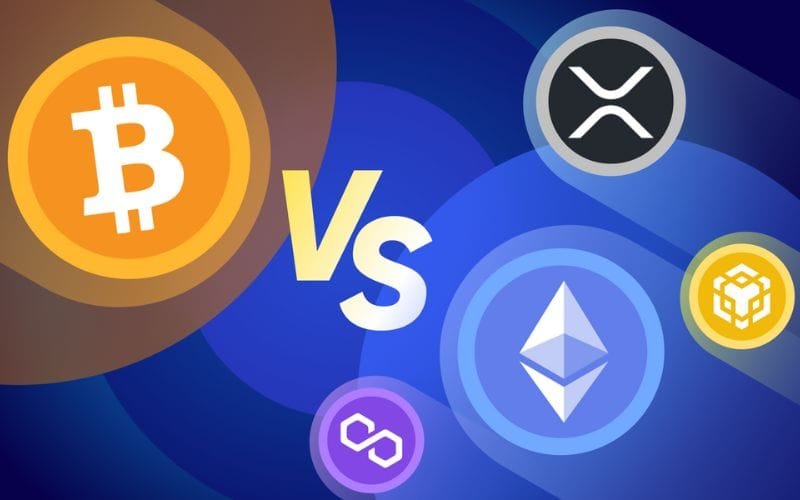
Altcoins differentiate themselves from Bitcoin by addressing perceived limitations and expanding on its capabilities. Various altcoins, such as Litecoin (LTC), Ethereum (ETH), Bitcoin Cash (BCH), and Zcash (ZEC), have been compared to Bitcoin in several aspects to showcase their unique features.
Litecoin vs. Bitcoin
Bitcoin will still be the choice of many people in 2024
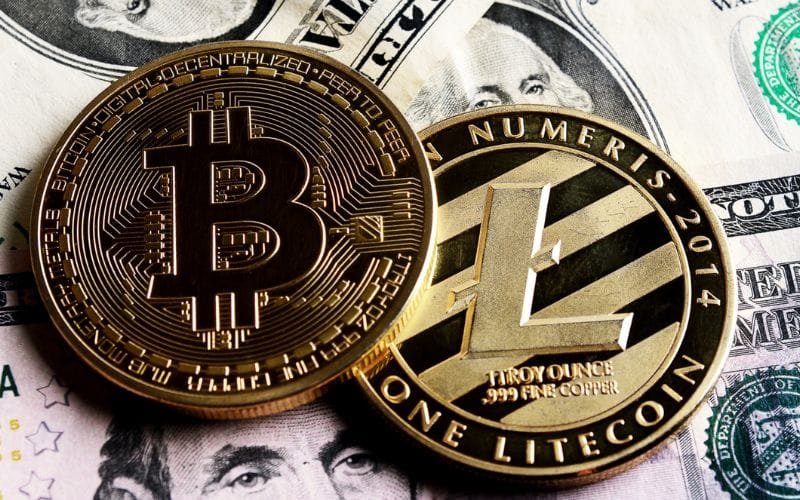
Launched on October 7, 2011, Litecoin was one of the first altcoins created to improve upon Bitcoin’s design. While it shares many similarities with Bitcoin, Litecoin reduces the block creation time from 10 minutes to 2.5 minutes, aiming to increase transaction speed across the network. However, this reduction can result in orphaned blocks, which created scalability challenges during times of heavy transaction volume, such as in December 2017.
To address these issues, Litecoin implemented Segregated Witness (SegWit), MimbleWimble, and the Lightning Network to improve scalability. Additionally, Litecoin uses the Scrypt algorithm, which differs from Bitcoin’s SHA-256 and relies more on memory for mining, making it more efficient. Litecoin also increased the maximum coin supply to 84 million, compared to Bitcoin’s 21 million, which provides a more accessible unit of trade for users.
Ethereum vs. Bitcoin
Ethereum, introduced on July 30, 2015, is another prominent altcoin that differs from Bitcoin not just in terms of digital currency but also in its functionality. Rather than focusing solely on payments, Ethereum uses blockchain technology to power a decentralized, Turing-complete virtual machine capable of running smart contracts and decentralized applications (dApps).
With features like smart contracts, faster block times (14 seconds), and scalability improvements, Ethereum stands apart from Bitcoin’s simpler structure. Unlike Bitcoin, which is primarily seen as a store of value, Ethereum adds intrinsic value through its utility in running decentralized applications, its disinflationary supply, and innovations like its transition to Proof of Stake (PoS).
Bitcoin Cash vs. Bitcoin
Bitcoin Cash (BCH) was created on August 1, 2017, as a fork of Bitcoin to address its scaling issues. Initially adopting SegWit to manage transaction congestion, BCH later increased its block size from 1 MB to 8 MB, allowing for more transactions per block and reducing transaction fees.
Supporters of Bitcoin Cash view it as better suited for everyday transactions, while Bitcoin is regarded as a store of value. This distinction highlights the different purposes these two cryptocurrencies serve within the blockchain ecosystem.
Zcash vs. Bitcoin
Zcash (ZEC), launched on October 28, 2016, is an altcoin that builds on Bitcoin’s concept of pseudonymity by offering fully anonymous transactions. With block times reduced to 2.5 minutes, Zcash processes transactions faster than Bitcoin. To handle the increased complexity of its privacy features, Zcash doubled Bitcoin’s block size to 2 MB, providing more space for its enhanced transaction data. Zcash focuses on privacy and anonymity, setting it apart from Bitcoin’s more transparent model.
How Do Altcoins Work?
Do Altcoins Work the Same as Bitcoin?
Altcoins operate using the same underlying blockchain technology that Bitcoin introduced, but they are not all identical to Bitcoin’s Proof-of-Work (PoW) consensus mechanism. In PoW, computers, or “nodes,” on the blockchain solve complex mathematical puzzles to validate new cryptocurrency transactions and earn rewards. Some altcoins, such as Litecoin and Dogecoin (DOGE), also rely on PoW’s “crypto mining” process.
However, many altcoins use alternative methods for reaching consensus. One popular alternative is Proof-of-Stake (PoS), where nodes stake the blockchain’s cryptocurrency to verify transactions and earn rewards. Examples of PoS altcoins include Ethereum, Polkadot (DOT), and Solana (SOL). Any cryptocurrency that leverages blockchain technology to provide decentralized peer-to-peer (P2P) transactions qualifies as an altcoin.
Altcoins can be classified as either coins or tokens. A coin is a cryptocurrency that operates within its own blockchain protocol, whereas tokens are built on top of an existing blockchain. For instance, Litecoin is considered a coin because LTC operates on its own blockchain. On the other hand, a token like Chainlink’s LINK is built on the Ethereum blockchain, rather than having its own unique infrastructure. Despite the term “altcoin” including “coin,” tokens are also considered altcoins, as they offer alternatives to Bitcoin.
How To Buy Altcoins In 2024?
Purchasing altcoin can be a rewarding experience, but it’s important to proceed with caution and fully understand the risks. Here are some key steps to consider when buying and trading altcoins:
- Conduct Research: Before buying any altcoin, it’s vital to perform thorough research on the project, its team, and its potential use cases. Knowing the fundamentals of an altcoin can help users make well-informed decisions when trading.
- Select a Reliable Platform: To trade altcoins, users must create an account on a cryptocurrency exchange. It’s essential to choose a secure and reputable platform that supports the altcoins you are interested in. Popular options include platforms like the Crypto.com App.
- Develop a Trading Plan: Creating a clear trading plan with defined goals, risk tolerance, and strategies will help keep users disciplined and focused on their trading objectives.
- Manage Risk Effectively: It’s important to implement risk management techniques, such as using stop losses and appropriate position sizing, to protect your capital when trading altcoins.
- Stay Updated: Stay informed about the latest news and trends in the cryptocurrency market, as changes in the market can significantly affect altcoin prices.
How to Invest in Altcoins for 2024?
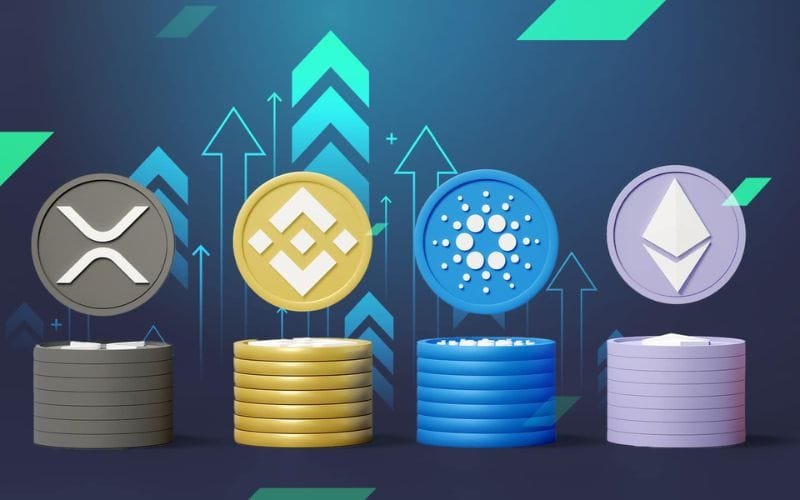
Should you invest in Altcoins now?
Step-by-Step Guide to Buying Altcoins on Exchanges
- Choose a Cryptocurrency Exchange: Select a reputable platform that supports altcoin trading, such as Binance or Coinbase.
- Create an Account: Sign up for an account on your chosen exchange and complete any necessary identity verification.
- Deposit Funds: Fund your account with fiat currency or cryptocurrencies like Bitcoin or Ethereum.
- Search for Altcoins: Navigate the exchange to find the altcoins you want to purchase.
- Place an Order: Decide on the amount of altcoin you want to buy and place a market or limit order.
- Confirm Your Purchase: Review the transaction details and confirm your purchase.
Storing Your Altcoins Securely
After purchasing altcoins, consider transferring them to a secure wallet. Options include:
- Hot Wallets: Online wallets connected to the internet for easy access but with higher security risks.
- Cold Wallets: Offline wallets, like hardware wallets, that provide enhanced security for long-term storage.
Risks Associated with Altcoin Trading and Tips for Beginners
- Volatility: The altcoin market is highly volatile, with prices subject to rapid fluctuations.
- Scams and Frauds: Be cautious of projects that lack transparency or credible teams.
- Do Your Own Research (DYOR): Thoroughly research altcoins before investing, focusing on their use cases, technology, and market potential.
- Invest Only What You Can Afford to Lose: Given the risks, only invest money that you can afford to lose.
- Diversify Your Portfolio: Avoid putting all your funds into a single altcoin; instead, spread your investments across multiple projects
Benefits Of Altcoins
Expanding the Capabilities of Blockchain Technology
Altcoins enhance blockchain functionalities beyond simple transactions. With the introduction of smart contracts and decentralized applications (dApps) on platforms like Ethereum, they allow automation of agreements and creation of complex decentralized systems. This broadens the scope of what blockchain technology can achieve.
Investment Diversification
Altcoins provide investors with diverse opportunities, catering to different risk appetites. By offering exposure to various blockchain innovations, altcoins allow for portfolio diversification, which can help manage risk and capitalize on emerging trends in the cryptocurrency space.
Innovation in Privacy, Security, and Scalability
 Improved security and privacy for a better user experience
Many altcoins are focused on addressing key challenges faced by early cryptocurrencies. Privacy coins like Zcash and Monero prioritize transaction anonymity, while platforms like Cardano and Solana aim to improve scalability and security. These innovations push the boundaries of blockchain’s potential.
Specific Use Cases in Various Industries
Altcoins are increasingly being applied in specific industries such as healthcare, finance, and entertainment. For instance, blockchain solutions are being used for secure data sharing in healthcare, faster cross-border payments in finance, and the creation of new digital economies in entertainment, such as tokenized assets and NFTs.
Pros And Cons Of Altcoins
 What are the pros and cons of Altcoins?
Pros
- Altcoins enhance certain features that Bitcoin lacks.
- They offer the potential for substantial rewards.
- There is a wide variety of altcoins, each with its own unique use cases and competitive advantages.
Cons
- Altcoins don’t benefit from Bitcoin’s first-mover advantage or its large market share.
- They come with significant risk, as many altcoins may be scams or fail over time.
- Some altcoins are difficult to purchase, as they are only available on specific altcoin exchanges.
Examples Of Altcoins
The cryptocurrency market includes thousands of altcoins. Here are a few notable examples:
- Namecoin (NMC): Launched in April 2011, Namecoin was one of the earliest altcoins. It shares similarities with Bitcoin, as it is based on Bitcoin’s code and has the same supply cap of 21 million coins. Namecoin is best known for introducing .bit domains, which promote anonymity and are resistant to censorship.
- Ethereum (ETH): Released in July 2015, Ethereum was the first altcoin to offer a programmable blockchain, allowing developers to create decentralized applications (dApps). It quickly became the second-largest cryptocurrency, trailing only Bitcoin.
- USD Coin (USDC): Launched in September 2018, USD Coin is a stablecoin pegged to the U.S. dollar. It is governed by Centre, a consortium that includes Coinbase Global, Inc. (COIN), providing stability in the volatile crypto market.
What To Consider Before Buying Altcoins?
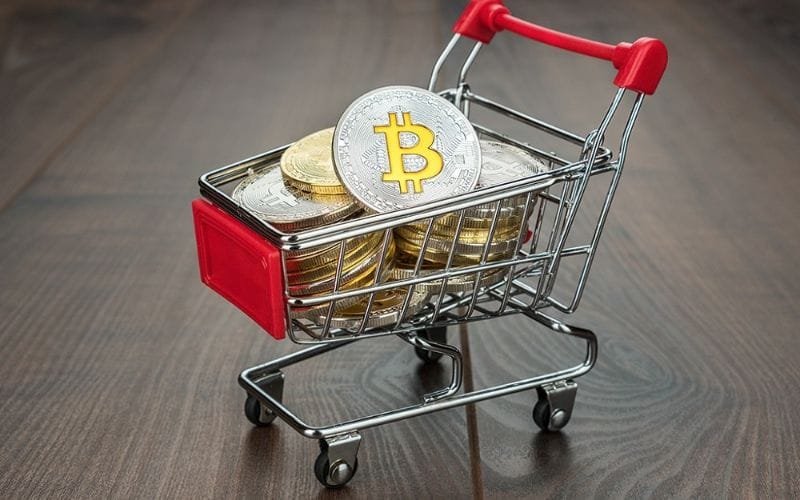
What features should you pay attention to when buying Altcoins?
Investing in lesser-known altcoins can be even riskier than putting money into the top few cryptocurrencies. Here are some key factors to consider before diving into altcoins in hopes of hitting it big:
- Altcoins are driven by sentiment: Unlike stocks, which are often backed by a company’s assets or cash flow, cryptocurrencies, including altcoins, rely heavily on market sentiment. Optimism can push prices higher, while pessimism can lead to steep declines. The success of an altcoin often depends on whether traders are, or become, more optimistic about it.
- Investors gravitate toward popular cryptocurrencies: Since the market is sentiment-driven, most investors tend to focus on well-known coins like Bitcoin and Ethereum, along with a few others. Although some altcoins, such as Dogecoin and Shiba Inu, have experienced moments of popularity, many altcoins remain obscure. If an altcoin falls out of favor, it might never regain traction, potentially leading to significant or total losses.
- Can you afford to lose your investment?: Given the high risks and volatility of altcoins, it’s important to ask yourself if you’re investing only money you can afford to lose. Cryptocurrency markets are highly speculative and are not the place to risk funds that you need for essential expenses.
- Assess the technical features of an altcoin: If you’re considering investing in an altcoin, take time to research its technical capabilities. For example, some altcoins, like Solana, have gained popularity due to their high functionality and low costs. A cryptocurrency’s unique features may help it maintain visibility in the market, making it more appealing for traders.
When investing in speculative assets like altcoins, always be prepared for the possibility of losing your entire investment and expect extreme market volatility as a minimum.
Altcoin – Frequently Asked Questions
 FAQs for Altcoin
What Is Considered an Altcoin?
An altcoin refers to any cryptocurrency other than Bitcoin (and, for some, Ethereum as well).
What Are the Top 5 Altcoins?
The top five altcoins by market capitalization are ETH (Ethereum), USDT (Tether), BNB (Binance Coin), SOL (Solana), and USDC (USD Coin).
What Altcoin Will Explode in 2024?
Predicting which altcoin will surge in 2024 is speculative. The market could remain stable, or a new altcoin could emerge, drawing significant attention from investors.
What is Altcoin Season?
Altcoin season, often referred to as “altseason,” is a time when alternative coins outperform Bitcoin in terms of price and growth. During this phase, investors start focusing on various altcoins that exhibit high growth and profit potential. Altcoin season presents traders with an opportunity to diversify their portfolios and potentially achieve higher returns.
How to Buy Altcoins?
You can purchase altcoins through various cryptocurrency apps, exchanges, and brokerages. If you’re a first-time cryptocurrency investor, you’ll need to deposit fiat currency into an account on a platform that allows you to trade fiat for altcoins. Alternatively, you can first buy Bitcoin or Ethereum and then exchange them for your preferred altcoins on the platform.
How to Store Altcoins?
Once you purchase altcoins, they will typically show up in your account on the exchange or platform, known as hot storage. While hot storage is convenient, it is more susceptible to hacking since it’s connected to the internet. To enhance security, many investors opt for cold storage, which involves keeping their altcoins offline in hardware wallets that offer strong security features.
Are Altcoins Secure?
Yes, altcoins are secure. Like Bitcoin, altcoins utilize blockchain technology to create a secure environment for peer-to-peer transactions. They employ complex cryptographic techniques that enable users to conduct transactions without needing a central authority.
How to Pay in Altcoins?
With a growing number of merchants accepting cryptocurrency payments, you can use altcoins to pay for your purchases as long as the merchant supports them. To do this, initiate a cryptocurrency transfer from your wallet and input the merchant’s public wallet address as the recipient. In some cases, you can simply scan a QR code to access the address for payment.
Are Altcoins Riskier Than Bitcoin?
Altcoins often exhibit higher volatility and carry more speculative risks compared to Bitcoin. However, they also offer unique possibilities for innovation and can provide significant potential rewards.
Can Altcoins Replace Bitcoin?
Altcoins build upon Bitcoin’s foundation by offering additional features, but Bitcoin continues to hold its place as a leading store of value. It’s more likely that altcoins will complement Bitcoin rather than fully replace it.
Future Of Altcoins
Altcoins will grow more and more in the coming years
The future of altcoins and cryptocurrencies can be likened to the historical context surrounding the establishment of a federally issued dollar in the 19th century. During that time, various local currencies were in circulation across the United States, each with its own distinct characteristics and backing instruments. Local banks also issued their currencies, sometimes relying on non-existent reserves. This diversity mirrors the current landscape of the altcoin market, where thousands of altcoins exist, each claiming to fulfill a specific purpose and serve a unique market.
The current dynamics in the altcoin market suggest that it is unlikely to converge into a single cryptocurrency. However, many of the thousands of altcoins available today may not survive long-term. The market is expected to gravitate toward a select few altcoins that offer strong utility, practical use cases, and a well-defined blockchain purpose, which will likely dominate the cryptocurrency landscape.
For those looking to diversify within the cryptocurrency space, altcoins often come at a lower cost compared to Bitcoin. Nevertheless, it’s important to note that the cryptocurrency market, irrespective of the coin type, is still relatively young and highly volatile. As the role of cryptocurrency in the global economy continues to evolve, a cautious approach to investing in all cryptocurrencies, including altcoins, is advisable.
Conclusion
As we venture into 2025, the cryptocurrency landscape continues to evolve at a rapid pace. The altcoin market, in particular, is poised for significant growth and innovation. With countless new projects emerging and technological advancements driving the industry forward, the future of digital assets appears brighter than ever. Coinreviews remains committed to providing our readers with the most up-to-date and insightful analysis of the altcoin market. By staying informed about the latest trends and developments, you can make more informed investment decisions and position yourself for success in this exciting and dynamic space.
Best Crypto Exchange Reviews:
- Binance Review: Features, Supported Cryptos and Fees!
- Bybit Review: Pros, Cons and Key Features
- OKX Review: Pros, Cons, Future Potential & More
- HTX Review: Fees, Security, Pros & Cons
- Bitget Review: Pros & Coins, Fees & More
- Bitfinex Review: Is It Secure or Scam?
- Kucoin Review: Social Trading, Fees, Pros & Cons
- Crypto.com Review: Is the Exchange Safe or Scam?
- BingX Review: Verified Reviews, Pros & Cons
- LBank Review: Should You Use It?
- bitFlyer Review: Pros & Cons and Ratings
- ProBit Review: Is It the Right Crypto Exchange for You?
- P2B Review: Fees, Features, Safety, Pros & Cons
- Pionex Review: Pros, Cons & All You Need to Know
- BitMEX Review: Fees, Trading, Staking & More
- Phemex Review: Is It a Good Crypto Exchange?
- BTSE Review: Is It Safe & Reliable?
- CoinEx Review: Is This Crypto Exchange Safe?
- Poloniex Review: Features, Regulation & Risks
- BITFLEX Review: Features, Safety, Pros & Cons
- CoinJar Review: Is It the Right Exchange for You?
- Paymium Review: Pros, Cons, Key Features & Fees
- LBank Review: Is It the Right Exchange for You?
- MEXC Review: Latest Pros, Cons, Key Features & Fees
- BitMart Review: Reviews, Trading Fees & Cryptos
- Margex Review 2025: Is the Exchange Safe or Scam?
See More: