
The year 2024 marks a pivotal moment in the evolution of blockchain technology, with Ethereum poised to undergo a transformative upgrade. As the world’s second-largest cryptocurrency by market capitalization, Ethereum has been at the forefront of innovation in the decentralized finance (DeFi) and non-fungible token (NFT) spaces. The highly anticipated Ethereum 2.0 upgrade promises to address some of the platform’s most pressing scalability and security challenges, ushering in a new era of decentralized applications (dApps).
Coinreviews will delve into the key features and implications of the Ethereum 2.0 upgrade, exploring how it will impact the broader cryptocurrency ecosystem and shape the future of blockchain technology.
What Is Ethereum?
Ethereum is a global, decentralized software platform built on blockchain technology. It is widely recognized by investors for its native cryptocurrency, ether (ETH), and by developers for its pivotal role in building decentralized applications (DApps) and blockchain-based solutions.
Designed to be scalable, programmable, secure, and decentralized, Ethereum allows anyone to create secure digital technologies. Its native token, ether, is primarily used to compensate participants for supporting the blockchain, though it can also be used to pay for goods and services where accepted.
Ethereum is chosen by many people to buy today
Highlights
Ethereum is a blockchain-powered platform widely known for its cryptocurrency, ether (ETH).
The blockchain technology behind Ethereum enables the creation and maintenance of secure digital ledgers accessible to the public.
While Ethereum and Bitcoin share some similarities, they have distinct long-term goals and limitations.
Ethereum operates on a proof-of-stake mechanism for transaction validation.
Ethereum serves as the backbone for many emerging innovations in the blockchain space.
History of Ethereum
2013
At just 19 years old, computer programmer Vitalik Buterin, also a co-founder of Bitcoin Magazine, publishes a white paper proposing a highly flexible blockchain—Ethereum—that could support nearly any type of transaction. Brian Armstrong, CEO and co-founder of Coinbase, later discussed topics like ETH2 and the growing crypto economy with Buterin.
2014
Vitalik Buterin, along with a team of co-founders, including Gavin Wood, raises $18 million to fund the development of the Ethereum protocol through the sale of pre-launch tokens.
2015
In July, the first public version of the Ethereum blockchain is officially launched, introducing the concept of smart contracts to the world.
2016
Hackers exploit a vulnerability in a smart contract-powered venture capital fund known as the Decentralized Autonomous Organization (DAO), resulting in a $50 million theft. This event leads to a community debate, with the majority of the Ethereum community voting to revise the protocol and recover the lost funds. This decision creates a hard fork, splitting the blockchain into two: Ethereum and Ethereum Classic.
2017
The creation of the ERC-20 standard simplifies the process for developers to create tokens on the Ethereum blockchain. The year also marks the release of the first viral Ethereum-based app, CryptoKitties, a game where users could collect and trade digital cats, with some rare cats selling for over $200,000 at the height of the frenzy.
In the same year, the Enterprise Ethereum Alliance (EEA) is launched, aiming to develop practical smart contract applications with major companies like JP Morgan, Samsung, Microsoft, and Mastercard as members. Ethereum also sees the launch of MakerDAO, the first decentralized finance (DeFi) protocol, along with the introduction of DAI, the first stablecoin backed by Ethereum. ETH surpasses the $100 mark for the first time.
2018
DeFi continues to gain traction on the Ethereum blockchain with the launch of lending protocol Compound and decentralized exchange protocol Uniswap. The USDC stablecoin, backed by Coinbase and Circle through the CENTRE Consortium, launches and reaches $1 billion in circulation within its first year. In early 2018, ETH reaches over $1,000, though it later dips below $100.
2020
The upgrade to Ethereum 2.0 begins in December, starting the transition from Ethereum 1.0 to a fully PoS-based blockchain. The complete upgrade is expected to take about two years, with Proof of Stake (PoS) introduced in the first phase, while Ethereum 1.0 continues using Proof of Work (PoW).
2021
ETH hits an all-time high of $4,891 in November 2021, reflecting Ethereum’s growing role in the crypto world.
You can check the current Ethereum price at:
https://www.coinbase.com/price/ethereum
How Ethereum Works?
Does Ethereum work like other cryptocurrencies?
Blockchain Technology
Ethereum operates on a blockchain, which is essentially a distributed ledger system. It functions like a database, where each block holds encoded data from both the previous block and new information. This forms a secure chain of data that cannot be altered. The Ethereum blockchain is distributed across a network, with each participant holding an identical copy of the blockchain.
New blocks are generated by validators who are rewarded with ether tokens for verifying the data in the block and proposing new blocks. These tokens are assigned to the validator’s Ethereum address. After a new block is proposed, a network of automated programs reaches consensus by validating the transaction data. On the Ethereum blockchain, this process happens when the consensus layer communicates with the execution layer. The block is finalized once enough validators verify the data and agree on the results.
Proof-of-Stake Validation Process
Ethereum transitioned from a proof-of-work system to proof-of-stake (PoS) to reduce the energy-intensive mining process. Instead of miners, validators are responsible for verifying transactions and blocks. The Ethereum PoS system relies on a finalization protocol called Casper-FFG and an algorithm named LMD Ghost, combined in a consensus mechanism called Gasper. Gasper ensures that validators receive rewards for their work or are penalized for dishonest actions.
To become a solo validator, an individual must stake 32 ETH, enabling them to validate transactions. If someone has less ETH, they can join a validation pool, where rewards are shared. Validators verify blocks and confirm that the transaction data is accurate through a process called attestation. Once a validator attests to a block’s validity, it is broadcast to other validators, known as a committee, who then vote on its legitimacy.
Validators who attempt dishonest behavior or try to attack the Ethereum network are punished. Gasper identifies these malicious activities by flagging suspicious blocks and ensuring that dishonest validators have their staked ETH “burned.” This process involves sending the tokens to an irretrievable address, effectively removing them from circulation.
Wallets
People who own ether on Ethereum use wallets to store their private keys. A wallet acts as a digital interface, allowing users to access their cryptocurrency. Much like an email address, a wallet address is where users send and receive ether.
However, ether itself isn’t stored in the wallet. Instead, the wallet holds private keys, which function like passwords to authorize transactions. Each ether held has a corresponding private key, which is essential for accessing the cryptocurrency. Without the private key, users cannot access their ether, which is why securing these keys through various storage methods is so important in the Ethereum ecosystem.
Use Cases of Ethereum in 2024

What are the use cases for Ethereum?
Ethereum has a wide range of applications, including:
- DeFi (Decentralized Finance): Ethereum powers decentralized financial platforms, enabling users to access banking-like services such as lending, borrowing, and trading without intermediaries.
- NFTs (Non-fungible Tokens): Ethereum hosts the majority of NFTs, which are digital assets representing ownership of unique items like digital art, music, and collectibles.
- DAOs (Decentralized Autonomous Organizations): Ethereum facilitates the creation of DAOs, organizations governed by smart contracts and collective decision-making, without the need for centralized control.
- Other industries: Ethereum is being applied in various sectors such as supply chain management, gaming, and healthcare, revolutionizing these industries through transparency, automation, and security.
Ethereum’s key characteristics
Let’s explore the main characteristics of Ethereum as a platform and examine their implications:
Open and Permissionless Access
Ethereum offers open, unrestricted access to anyone who wants to create, run, or use applications on its network. There’s no selective approval of which applications can operate, and users don’t need to create an account or seek permission to develop, deploy, or use applications. Instead, resources are allocated based on market demand. This creates a truly democratized environment where anyone, from anywhere, can access finance protocols, such as lending and borrowing, built on Ethereum. Additionally, anyone can build applications that are globally accessible without relying on approval from intermediaries.
Transparency

Is Ethereum transparent compared to other cryptocurrencies?
The Ethereum platform ensures that everyone has visibility into how both the operating system and the applications function. There are no hidden algorithms or proprietary software, giving users the ability to evaluate every detail of an application before engaging with it. Furthermore, the history of any application running on Ethereum is fully transparent. For example, anyone can trace exactly how much collateral has been held in a lending protocol from its inception to the present day.
Immutability
Once the Ethereum network reaches consensus on the state of the shared ledger, that state becomes a permanent, unchangeable record. In computing, “state” refers to the stored information within a system. The immutability of these states, both current and historical, combined with Ethereum’s transparency, provides participants with a high degree of confidence that fraud or manipulation isn’t occurring. Instead of relying on intermediaries or auditors to track information, participants can verify everything on Ethereum themselves.
Durability
The decentralized and distributed nature of Ethereum makes both the network and its applications incredibly resilient to shutdowns. The “distributed” aspect means that Ethereum’s computational power and memory are spread across the globe. “Decentralized” indicates that no single entity controls Ethereum. While there are public figures associated with Ethereum, it isn’t owned or controlled by any one individual or organization. Even though governments could attempt to ban Ethereum or target key figures, it would be exceedingly difficult to prevent ordinary users from accessing it or to completely shut the network down.
Neutrality
Ethereum’s protocol evolves through a consensus-driven process that is quasi-political, with the goal of maintaining “credible neutrality.” This ensures that Ethereum adapts to the needs of participants in a way that provides a higher level of assurance. Users can trust that they will always have fair access to the network’s resources and that the platform will not favor one group over another as it evolves. This stands in contrast to traditional proprietary computing models, making Ethereum more inclusive and equitable.
Is Ethereum Risk-Free?
While Ethereum is secured by its blockchain technology, specifically using Proof of Stake (PoS), it is not entirely without risk. The underlying concept of cryptocurrencies, including Ethereum, promotes security by operating without centralized control, and its basic software is open source. This transparency allows many computer scientists and cryptographers to continuously examine the Ethereum network from various perspectives to ensure its security.
However, the security of decentralized applications (dApps) built on the Ethereum blockchain depends solely on the developers of those applications. Bugs or vulnerabilities in the code can lead to financial losses, even though the source code is visible to the public. Since the user bases of individual applications are much smaller compared to the global Ethereum network, they often receive less scrutiny. Therefore, it’s essential to research any decentralized application (dApp) before using it on Ethereum to minimize risks.
What is Ethereum 2.0?
Ethereum 2.0 (or ETH2) represents a significant upgrade to the Ethereum network, aimed at improving its scalability, security, speed, and efficiency. The transition took place in September 2022 when the original Ethereum blockchain was merged with the ETH2 blockchain. This update allows Ethereum to support greater growth and adapt to increasing demands.
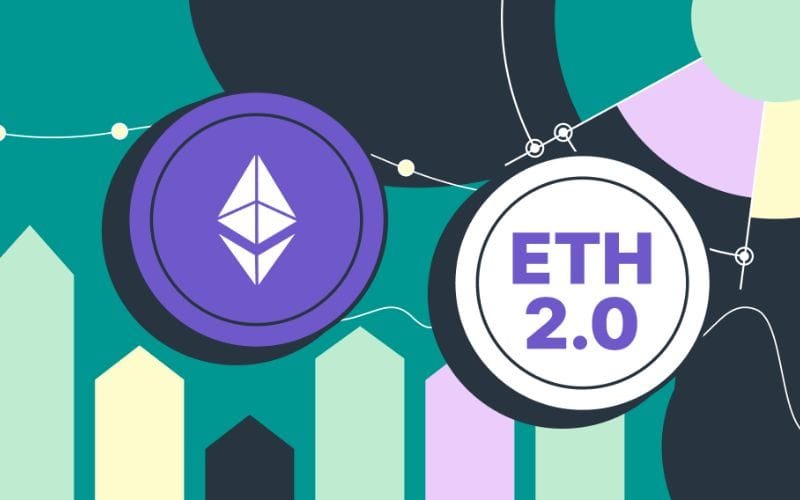
Ethereum 2.0 a perfect upgrade
Why is Ethereum 2.0 Necessary?
Migrating a popular cryptocurrency like Ethereum to a new platform was a challenging but essential step for the network’s evolution. The original Ethereum blockchain (ETH 1.0) used the Proof-of-Work (PoW) consensus mechanism, which led to network congestion, higher fees, and excessive energy consumption. These issues made it clear that Ethereum needed to evolve to address these bottlenecks and improve the overall user experience.
What is Proof of Work?
Proof of Work (PoW) is the original consensus mechanism used by Ethereum and other cryptocurrencies like Bitcoin to ensure transactions are valid and prevent double-spending without the need for a central authority, such as Visa or PayPal. When Ethereum 1.0 was launched, it adopted Bitcoin’s PoW model, which relies on miners competing to solve complex mathematical puzzles.
The first miner to solve the puzzle gets the opportunity to update the blockchain with the latest verified transactions and is rewarded with a certain amount of ETH. On Ethereum, this process happens roughly every 30 seconds, much faster compared to Bitcoin’s 10-minute intervals. However, as Ethereum’s network traffic increased, the PoW system struggled with congestion, leading to unpredictable fee spikes and delays.
Ethereum Today
The grand vision of Ethereum as a cornerstone for the next generation of the Internet is gradually coming to life. However, the reality is that Ethereum remains in its early stages and, at this point, is not yet equipped at the infrastructure level to handle the complexity of large-scale systems like decentralized social networks.

Ethereum has been getting better and better in recent years
That said, Ethereum is actively being used today for a wide array of applications and services, including:
- Decentralized Finance (DeFi): DeFi seeks to create an open and permissionless financial ecosystem. Users can lend, borrow, trade, and earn interest on their assets without depending on traditional financial institutions.
- Non-Fungible Tokens (NFTs): Ethereum supports the creation of NFTs, which are one-of-a-kind digital assets authenticated via blockchain technology. NFTs have seen significant growth, particularly in art and collectibles, representing unique ownership of artwork, digital items, or even real estate.
- Gaming: Ethereum has paved the way for a new generation of blockchain-based games. These games often feature tradable in-game assets, such as characters, skins, or weapons, represented as NFTs. Gaming is emerging as one of the most promising use cases for cryptocurrencies.
- Decentralized Autonomous Organizations (DAOs): DAOs function like organizations or businesses without a centralized authority. Decision-making and rules are governed by the community through a voting system and are executed using smart contracts on Ethereum. DAOs can serve various purposes, from governance to investment decisions or collaborative ventures.
- Identity and Reputation Systems: Ethereum is being used to build decentralized identity frameworks, allowing users to own and manage their personal data without relying on governments or corporations. These systems can be utilized for website logins or to verify product authenticity.
- Supply Chain Tracking: Businesses are adopting Ethereum to monitor the production and distribution of goods transparently. For instance, consumers can scan a product’s QR code to trace its entire history, from its production to its placement on the shelf.
What is staking?
The founders of Ethereum recognized the limitations of the Proof-of-Work (PoW) consensus mechanism, which led them to develop a different solution for Ethereum 2.0. This upgrade aims to enable the Ethereum network to efficiently handle thousands of transactions per second.
Ethereum 2.0 introduces the Proof-of-Stake (PoS) consensus mechanism, which is faster, more energy-efficient, and theoretically more secure than PoW. Like PoW, PoS also selects one participant to verify the latest transactions, update the blockchain, and earn ETH as a reward.
However, instead of a network of miners competing to solve complex puzzles, Ethereum’s Proof-of-Stake relies on a network of trusted participants, known as validators, who have a stake in the success of the network.
Validators contribute to a “staking pool” by depositing ETH, a process known as staking. When you stake your ETH, you earn rewards based on the amount you’ve staked and the length of time it remains in the pool.
The network selects a validator to verify the latest block of transactions based on the amount of ETH they have staked and the duration of their stake. This process literally rewards the participants most invested in Ethereum.
Once the chosen validator validates the block, other validators confirm its accuracy through a process called attestation. When enough attestations are collected, the blockchain is updated. Each validator involved.
Investing in Ethereum

Should you invest in Ethereum at this time?
Ethereum has become one of the most popular cryptocurrencies, attracting a wide range of investors due to its versatile platform and potential for growth. If you’re considering investing in Ethereum, here’s what you need to know:
How to Buy and Store Ethereum?
Buying Ethereum is a straightforward process. You can purchase it through a cryptocurrency exchange, such as Binance, Coinbase, or Kraken. These platforms allow users to trade fiat currencies like USD or EUR for Ethereum (ETH). To get started, you’ll need to create an account on an exchange, complete identity verification (if required), and fund your account using your preferred payment method (credit card, bank transfer, etc.).
Once you’ve bought Ethereum, storing it securely is crucial. This is where cryptocurrency wallets come into play.
Ethereum Wallets: Hot vs. Cold Wallets
There are two main types of wallets for storing Ethereum: hot wallets and cold wallets.
Hot wallets are connected to the internet and are often offered by exchanges or in the form of software apps. They are more convenient for frequent trading and transactions but are also more vulnerable to hacks due to their online nature.
Cold wallets, on the other hand, are offline storage solutions such as hardware wallets (e.g., Ledger or Trezor) or paper wallets. Since they are not connected to the internet, cold wallets provide an added layer of security, making them ideal for long-term holding (also known as “HODLing”).
Choosing between hot and cold wallets depends on your investment goals. If you’re actively trading or using your Ethereum for decentralized applications (DApps), a hot wallet may be more convenient. However, if you’re looking to hold Ethereum securely over the long term, a cold wallet offers better protection.
Risks and Rewards of Investing in Ethereum
Like any investment, Ethereum comes with both risks and rewards:
- Rewards: Ethereum has demonstrated significant growth since its inception and is the backbone of various innovative technologies like decentralized finance (DeFi) and non-fungible tokens (NFTs). Its transition to Ethereum 2.0 and the move to Proof of Stake (PoS) have also addressed key issues such as energy consumption and scalability, potentially boosting its value in the future. Ethereum’s versatility, use cases, and strong developer community make it a promising long-term investment.
- Risks: However, the volatility of the cryptocurrency market is one of the biggest risks when investing in Ethereum. Price swings can be extreme, and regulatory uncertainty continues to impact the market. Additionally, the competition from other blockchains, such as Solana, Cardano, and Polkadot, may challenge Ethereum’s dominance in the future.
Price History and Future Predictions
Ethereum has experienced rapid price growth since its launch. It started trading at less than a dollar in 2015, and by 2021, it reached all-time highs above $4,000. This remarkable rise has attracted many investors, but it’s important to remember that Ethereum has also seen steep corrections during its history.
Looking ahead, many experts are optimistic about Ethereum’s potential, especially with the ongoing rollout of Ethereum 2.0 and its expanding ecosystem. However, like all speculative assets, predicting Ethereum’s price with certainty is challenging, and prospective investors should be prepared for both highs and lows in the future.
How does Ethereum generate value?
Ethereum’s value is determined in several ways. Like other assets, its price is influenced by market forces and can be traded for currencies such as bitcoins, dollars, euros, yen, and others 24/7. The price of Ethereum fluctuates daily based on demand, and as an emerging technology, it experiences more volatility compared to traditional currencies like the US dollar or large stocks from Fortune 500 companies.
However, the reasons behind Ethereum’s market value are more complex. Many investors see Ethereum’s worth in its flexibility as a platform, especially for issuing stablecoins and facilitating decentralized finance (DeFi) applications. This versatility contributes to the growing number of users and the increasing transaction fees on the network, driving its overall value.
Ether and Ethereum: What’s the Difference?
You can use Ether as a digital currency for financial transactions, as an investment, or as a store of value. Ethereum is the blockchain network where Ether is stored and exchanged. Beyond just holding ETH, the Ethereum network provides various additional functionalities.
“These transactions can be as simple as transferring funds, or more complex, such as exchanging assets, securing loans, or even purchasing digital art,” explains Boaz Avital, head of product at Anchorage. All these transactions are processed and stored on the Ethereum network.
Moreover, the Ethereum network can be used to store data and run decentralized applications. Instead of relying on centralized servers owned by companies like Google (GOOGL) or Amazon (AMZN), where the company controls the data, individuals can host applications on Ethereum’s blockchain. This gives users control over their data and allows open access to applications without any central authority overseeing them.
One of the most innovative use cases on Ethereum is the concept of self-executing contracts, known as smart contracts. Similar to traditional contracts, two parties agree to exchange goods or services in the future. However, unlike conventional contracts, there’s no need for lawyers. Instead, the agreement is coded onto the Ethereum blockchain, and once the conditions are fulfilled, the contract self-executes, automatically transferring Ether to the designated party
Ethereum vs. Bitcoin
Bitcoin is primarily used as a virtual currency and a store of value. While Ethereum also functions as a virtual currency and store of value, the decentralized Ethereum network goes further by enabling the creation and execution of applications, smart contracts, and other transactions. Bitcoin does not offer these additional capabilities.

Ethereum also processes transactions at a faster rate.
“New blocks on the Bitcoin network are validated approximately every 10 minutes, whereas Ethereum validates new blocks every 12 seconds,” says Gary DeWaal, chair of Katten’s financial markets and regulation group. Future updates to Ethereum could further accelerate its transaction speed, he adds.
Lastly, Bitcoin has a maximum supply of 21 million coins, with 19 million currently in circulation. In contrast, there is no fixed limit to the number of Ether tokens that can be created on the Ethereum network.
Benefits of Ethereum
Established and robust network: Ethereum boasts a well-established, proven network that has been operational for years, facilitating the exchange of billions in value. Its large, dedicated global community and the extensive ecosystem make it the largest in the blockchain and cryptocurrency space.
- Versatile functionality: Beyond its use as a digital currency, Ethereum enables a variety of financial transactions, execution of smart contracts, and data storage for third-party applications.
- Ongoing innovation: A vast community of Ethereum developers continuously strives to improve the network and create new applications. Due to its popularity, Ethereum is often the go-to blockchain for launching new and cutting-edge decentralized applications (which can sometimes carry risks).
- Eliminates intermediaries: The decentralized nature of Ethereum allows users to bypass intermediaries such as lawyers for contract drafting, banks for financial transactions, or third-party hosting services.
Disadvantages of Ethereum
- Rising transaction fees: As Ethereum’s popularity grows, so do the costs of transactions. Fees, commonly referred to as “gas,” can fluctuate significantly and become expensive, benefiting miners but creating higher costs for users.
- Risk of crypto inflation: While Ethereum has an annual cap of 18 million newly minted Ether, there is no lifetime limit, which could cause it to behave more like traditional currency and possibly limit long-term appreciation compared to Bitcoin’s fixed supply.
- Steep learning curve for developers: Transitioning to Ethereum’s decentralized environment from centralized systems can present challenges for developers, making it more difficult to adopt.
Should you buy Ethereum in 2025?
As the second-largest cryptocurrency by market capitalization, Ethereum is often considered the “silver” to Bitcoin’s “gold.” Like any high-risk investment, Ethereum has the potential for significant rewards, reflecting its inherent risk. Unlike the early days of crypto in 2009, Ethereum has moved beyond the proof-of-concept phase, making now a critical time for those who haven’t yet ventured into this asset class to explore its possibilities.
However, given the volatility and uncertainty surrounding the cryptocurrency market, it’s essential to thoroughly research before committing substantial retirement funds to Ethereum or any other digital asset. It may be a viable option for those looking for aggressive growth within a diversified portfolio, but remember only to invest what you can afford to lose.
Ethereum – Frequently Asked Questions

FAQs for Ethereum
What Will Ethereum Be Worth in 2030?
There are numerous predictions about Ethereum’s future price, but these are largely speculative. With so many variables influencing cryptocurrency valuations, it’s difficult to predict Ethereum’s price a week from now, let alone several years into the future.
Why Did Ethereum Drop?
The price of Ethereum fluctuates for various reasons throughout a trading day or week. Factors such as market sentiment, regulatory changes, news, hype, and other events all impact Ethereum’s value.
How Much Is One Ethereum Worth?
The price of Ethereum is highly volatile, but as of Oct 18, 2024, Ethereum was valued at approximately $2,597.8 per coin.
What are gas fees in Ethereum?
Gas fees are the costs users pay to miners or validators in exchange for confirming and completing transactions on the Ethereum blockchain.
How can I buy Ethereum?
You can purchase Ethereum from cryptocurrency platforms such as Binance, Coinbase, or Kraken.
Is Ethereum a good investment?
Ethereum has proven to be a major player in the cryptocurrency space, but like all investments, it involves risks due to market fluctuations.
What are NFTs on Ethereum?
NFTs, or Non-Fungible Tokens, are distinct digital assets created on the Ethereum network, often representing items like digital art, collectibles, or other exclusive content.
The Future of Ethereum

Does Ethereum have a future potential?
As Ethereum continues to evolve, its future holds exciting developments aimed at improving scalability, security, and overall efficiency. The completion of Ethereum 2.0 and various innovations will likely shape the platform’s long-term potential.
Ethereum 2.0 Final Phases and Beyond
Ethereum 2.0, a major upgrade to the Ethereum network, has been gradually rolling out in phases. One of the most significant milestones was “The Merge,” where Ethereum transitioned from a Proof of Work (PoW) to a Proof of Stake (PoS) consensus mechanism. This shift reduced the network’s energy consumption by over 99% and improved security.
Moving forward, Ethereum will continue implementing its roadmap for Ethereum 2.0, focusing on enhancing scalability through Sharding. Sharding will allow Ethereum to split its network into smaller, interconnected chains (or “shards”) that work in parallel, reducing congestion and increasing transaction throughput.
Scaling Solutions and Long-Term Sustainability
As Ethereum grows, scaling remains a critical challenge. High gas fees and slow transaction speeds during peak usage have been significant pain points for users. To address these issues, Layer 2 solutions, such as rollups (e.g., Optimism and Arbitrum), have emerged. These solutions handle transactions off-chain and then submit them to Ethereum, easing congestion and reducing costs.
In the long term, Ethereum aims to be a sustainable platform for a wide range of applications. Its PoS model reduces environmental impact, which could help Ethereum remain competitive as global attention shifts toward more eco-friendly technologies.
Potential for Mainstream Adoption
Ethereum’s adaptability makes it one of the most likely candidates for mainstream adoption within the cryptocurrency space. Its support for decentralized applications (DApps), decentralized finance (DeFi), and non-fungible tokens (NFTs) has already gained traction in sectors like finance, art, and gaming. As Ethereum 2.0 advances, faster and cheaper transactions may encourage more businesses and users to adopt the platform.
Institutional interest is also growing, with companies exploring Ethereum’s potential in areas such as supply chain management and digital identity verification. These use cases could further drive Ethereum’s mainstream adoption as the technology matures.
Future Innovations (Sharding, Layer 3)
In addition to Sharding, which will significantly enhance scalability, Ethereum’s future may also involve Layer 3 solutions. While Layer 2 is focused on improving transaction speed and efficiency, Layer 3 could take innovation further, offering specialized networks for privacy, enterprise use, and complex smart contract interactions.
With these innovations, Ethereum aims to maintain its leadership in the blockchain space and address the evolving needs of a rapidly expanding decentralized world.
The Bottom Line
In summary, 2024 promises to be a transformative year for Ethereum, as it boldly leads advancements in blockchain technology. With the successful rollout of Ethereum 2.0 and its continuous improvements, we’re poised to witness a surge of new and innovative applications. Serving as the backbone for decentralized finance (DeFi) and various other blockchain initiatives, Ethereum’s impact is unmistakable. Coinreviews asserts that Ethereum’s focus on scalability, security, and sustainability uniquely positions it to drive widespread blockchain adoption. As we look to the future, Ethereum is set to be a pivotal player in shaping the digital economy’s landscape.
Best Crypto Exchange Reviews:
- Binance Review: Features, Supported Cryptos and Fees!
- Bybit Review: Pros, Cons and Key Features
- OKX Review: Pros, Cons, Future Potential & More
- HTX Review: Fees, Security, Pros & Cons
- Bitget Review: Pros & Coins, Fees & More
- Bitfinex Review: Is It Secure or Scam?
- Kucoin Review: Social Trading, Fees, Pros & Cons
- Crypto.com Review: Is the Exchange Safe or Scam?
- BingX Review: Verified Reviews, Pros & Cons
- LBank Review: Should You Use It?
- bitFlyer Review: Pros & Cons and Ratings
- ProBit Review: Is It the Right Crypto Exchange for You?
- P2B Review: Fees, Features, Safety, Pros & Cons
- Pionex Review: Pros, Cons & All You Need to Know
- BitMEX Review: Fees, Trading, Staking & More
- Phemex Review: Is It a Good Crypto Exchange?
- BTSE Review: Is It Safe & Reliable?
- CoinEx Review: Is This Crypto Exchange Safe?
- Poloniex Review: Features, Regulation & Risks
- BITFLEX Review: Features, Safety, Pros & Cons
- CoinJar Review: Is It the Right Exchange for You?
- Paymium Review: Pros, Cons, Key Features & Fees
- LBank Review: Is It the Right Exchange for You?
- MEXC Review: Latest Pros, Cons, Key Features & Fees
- BitMart Review: Reviews, Trading Fees & Cryptos
See More: